
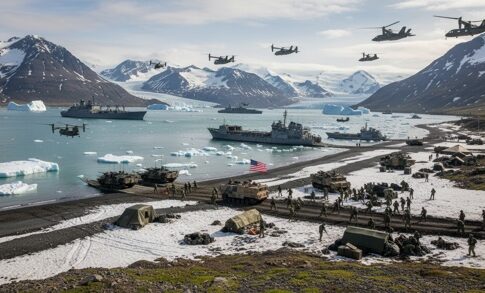
Danish soldiers now stand under a Cold War order that tells them to fire on any invader in Greenland—yes, even American troops—without calling home for permission.
A NATO Ally Quietly Loaded the First Round Decades Ago
Denmark wrote its most explosive message to Washington in 1952, long before anyone imagined a Trump tweet, a Greenland meme, or Arctic shipping lanes wide open in summer. Danish planners, staring down the Soviet Union, ordered their forces to “immediately take up the fight” against any attack on Danish territory without waiting for orders, even if no one had yet said the word “war.” That directive covered the whole kingdom—Greenland included.
Defence bureaucrats rarely write history, but this one memo now sits at the junction of American ambition, European anxiety, and Arctic strategy. When Trump returned to office and again elevated Greenland from punchline to “national security priority,” Danish journalists at Berlingske asked a deceptively simple question: does that 1952 order still bind today’s soldiers if the invader is wearing a US flag patch? Copenhagen’s answer was one word: yes.
Trump’s Greenland Obsession Meets Hard Arctic Reality
Trump did not stumble into Greenland; he circled it. In 2019, he floated buying the island and got laughed out of Copenhagen and Nuuk. In his current term, the laughter has been replaced with contingency planning. The White House now brands acquiring Greenland a US “national security priority,” tying it to missile defense, great‑power competition, and control of the Arctic approaches. Vice President JD Vance echoes that Denmark has not ensured Greenland can serve as an “anchor for world security.”
Americans who came of age when NATO meant “us and them” now face a stranger picture: a Republican administration openly keeping “military options” on the table against a treaty ally that fought beside the US from Afghanistan to the Baltics. Press Secretary Karoline Leavitt underscored that “utilizing the US military is always an option” regarding Greenland. For conservatives who still see alliances as force multipliers, not shackles, that rhetoric looks less like America First and more like Strategy Last.
Why Denmark Is Prepared to Trade NATO for Greenland
Denmark’s prime minister, Mette Frederiksen, cut through the diplomatic varnish: a US attack on Greenland would “mean the end of the NATO alliance and the security that has been established since the end of the Second World War.” That is not anti‑American chest‑thumping; it is a blunt statement of arithmetic. If Article 5 can be twisted to excuse one member seizing another’s territory, the mutual-defense promise shrinks to a slogan. At that point, Europeans would be fools, not allies, to bank on it.
From a conservative, common‑sense lens, her logic tracks. Sovereign borders either mean something, or they do not. If the US asserts a right to grab Greenland because it is strategically useful, Moscow and Beijing will read that as a green light to do the same in their neighborhoods—while calling Washington a hypocrite. Denmark’s reaffirmation of the 1952 directive functions as a tripwire deterrent: any invading force, even American, will be fired on immediately.
The Powder Keg Under the Ice Sheet
Strategically, Greenland is not a real‑estate hobby; it is the front porch of North America and the back door of Europe. US radar at Thule (now Pituffik Space Base) already watches for ballistic missiles arcing over the pole. Melting ice is opening shipping routes, resource access, and military maneuver space. That reality explains US interest, but it also explains why European allies closed ranks behind Denmark’s sovereignty and why Finland’s foreign affairs chair wants this on NATO’s North Atlantic Council agenda.
Public opinion in the US has not followed Trump’s rhetoric. A YouGov poll cited by The Independent found only 8 percent of Americans support using military force to seize Greenland, and even outright purchase wins less than one‑third support. That gap matters. It suggests conservative voters still recognize the difference between hard‑nosed national interest and needless adventurism. Shooting at Danish soldiers in the Arctic to acquire land that already hosts a key US base looks like the latter, not the former, to most Americans.
Greenland’s Next Move and the Conservative Test
Greenland itself is no longer the silent backdrop in a US‑Danish drama. Its government insists, “Nothing about Greenland without Greenland,” and demanded a seat at the upcoming talks with Secretary of State Marco Rubio and Danish officials. That stance fits a longer arc of autonomy: home rule in 1979, expanded self‑rule in 2009, and rising interest in eventual independence, all while defense and foreign policy remain in Copenhagen’s hands.
From a conservative perspective, what happens next is a test of whether Washington still respects self‑determination, treaty obligations, and the basic rule that friends do not threaten to invade friends to close a real‑estate deal. Rubio’s State Department line—that this is about diplomacy and, at most, purchase, not invasion—aligns more closely with those values than the saber‑rattling sound bites. Denmark’s 1952 order, now publicly reaffirmed, ensures that if anyone forgets those limits, the first reminder will not come from a press conference. It will come from the first shots over Arctic rock.
Sources:
NDTV: “‘Will Shoot First, Ask Questions Later’: Denmark Warns US Over Greenland Invasion”