
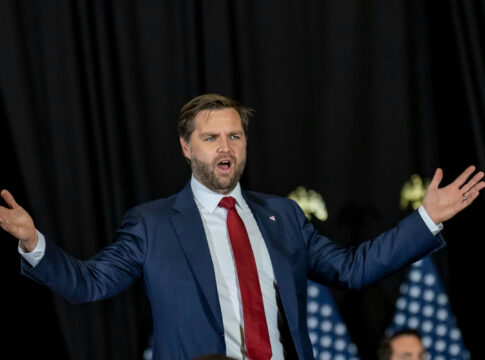
An organized effort inside the GOP establishment and allied media is working overtime to kneecap Vice President J.D. Vance before he can carry the MAGA torch into 2028.
How J.D. Vance Became Target Number One for the GOP Old Guard
The Spectator’s “plot against J.D. Vance” framing captures a deep struggle inside the Republican Party over who owns its future. Vance did not emerge from the traditional donor-and-think-tank pipeline; he rose as a populist voice, criticizing globalist trade deals and endless foreign interventions that many working‑class conservatives blame for hollowed‑out towns and stagnant wages. As Trump’s vice president, he is positioned as the most obvious heir to the MAGA agenda, which alarms the old guard that once controlled everything.
Historically, vice presidents are often their party’s next nominee, which is exactly why anti‑MAGA Republicans view Vance as a structural threat. According to the Spectator analysis, he was chosen not as a caretaker, but as a successor to lock in Trump’s populist realignment. Establishment figures understand that if Vance consolidates that position, their pre‑Trump model—corporate friendly economics, expansive foreign interventions, and accommodation with legacy media—could be shut out for an entire generation.
I really used to like JD Vance. Honestly. Unfortunately, speeches at AmFest by Carlson and Vance in opposition to Ben Shapiro got me thinking that perhaps JD Vance isn't principled enough to be a strong leader. You can read about it my latest Substack article, "JD Vance has an… pic.twitter.com/ITsrGiWZw8
— Joel Kleinbaum (@PostWokePNW) December 29, 2025
Media Litmus Tests and the Carlson–Fuentes Firestorm
The first major offensive against Vance did not come over a bill he wrote or a speech he gave, but over someone else’s interview. When Tucker Carlson hosted white nationalist Nick Fuentes in a relatively unchallenging conversation, critics on the right and left pounced. Because Vance is friendly with Carlson and employs Carlson’s son, establishment voices treated the episode as an opportunity to force a loyalty test: denounce Tucker on command or be smeared as soft on antisemitism and extremism.
Vance’s handling of that orchestrated test went to the heart of how conservative voters view media power. On CNN, he explicitly rejected antisemitism and “all forms of ethnic hatred,” but refused to accept a special, permanent obligation to police the statements of everyone he knows. For many grassroots conservatives, that refusal to bow to ritual denunciations signaled backbone. For his internal enemies, it became Exhibit A in a narrative that he is too radioactive to lead the ticket in 2028, regardless of what he actually believes.
Grassroots MAGA Support Versus Elite Narrative Warfare
While elites maneuver, the activist base has already signaled where its heart lies. At Turning Point USA’s AmericaFest gathering, Vance reportedly captured about 84 percent support in a straw poll of 2028 preferences, with traditional figures like Marco Rubio stuck in the low single digits. That kind of margin is not a blip; it reflects years of MAGA voters shifting away from country‑club Republicanism toward candidates who talk about trade, borders, and foreign wars the way they do at their own kitchen tables.
For older conservatives who watched GOP leaders promise border security, smaller government, and respect for faith and family—and then deliver bailouts, open borders, and cultural surrender—Vance’s economic populism and skepticism of foreign adventurism feel like a long‑overdue course correction. The push to paint him as an extremist looks less like a good‑faith concern and more like a replay of what was done to Trump: use accusations of bigotry and “dangerous rhetoric” to claw back control from voters who finally demanded results.
Law‑and‑Order Flashpoint: Minneapolis, ICE, and Media Outrage
Recent events around immigration enforcement in Minneapolis show how this plot plays out in real time. After an ICE agent fatally shot Renee Nicole Good during an encounter where she drove away from agents, federal officials described the incident as self‑defense, citing that the officer feared being rammed and had previously been seriously injured by a vehicle. State officials and some witnesses questioned that framing, and protests erupted, with activists and Democrats demanding state control of the investigation.
The plot against J.D. Vance https://t.co/bCE4dNcgD0 #JDVance #WhiteHouse #GOP #RNC #DNC #DIM #OVP #MAGA
— Donald G Boudreau, PhD, MPA (@DGBoudreau) January 8, 2026
Vance used a White House briefing to defend the agent, condemn what he called disgraceful media coverage, and accuse Democrats of inciting mobs against law enforcement. For many conservatives, this response aligns with long‑held frustration: years of seeing police and ICE officers vilified while violent criminals and repeat border crossers are given endless excuses. For his detractors, however, this becomes more ammunition—another chance to label him as extreme on immigration and out of step with polite society’s expectations.
Fraud Crackdowns, Walz, and the Establishment’s Fear of Accountability
Parallel to the immigration fight, Vance has made government fraud a signature focus, particularly after a major scandal in Minnesota involving alleged welfare and related fraud. He announced a multi‑state federal task force to track and prosecute fraud schemes and backed creation of a new Assistant Attorney General position devoted exclusively to fraud investigations. These steps speak directly to a conservative base angered by years of taxpayer dollars poured into bloated programs with little accountability for abuse and corruption.
Vance also went directly after Democratic Governor Tim Walz, calling him a joke and arguing that Walz either knew about the fraud, looked the other way, or enabled a culture where it flourished. Walz has since announced he will not seek another term. Critics called Vance’s language overheated, but many conservatives see a different pattern: whenever someone finally challenges waste, fraud, and abuse in blue states, establishment media fixate on tone, not substance. That pattern again feeds efforts to cast him as too divisive for national leadership.
What the Plot Against Vance Reveals About the GOP’s Future
Viewed together, the Carlson episode, the Minneapolis shooting controversy, and the fraud crackdowns reveal more than just hardball politics against one man; they expose a larger struggle over whether the Republican Party will remain a vehicle for populist, America‑first priorities or drift back to pre‑Trump habits. Establishment actors are betting that if they can redefine Vance as toxic—soft on antisemitism, harsh on immigrants, reckless on rhetoric—they can convince donors and suburban moderates to abandon him before 2028.
For conservative readers who care about borders, law and order, honest government, and protection of constitutional freedoms, these attacks read differently. They look like another attempt to silence anyone serious about enforcing immigration laws, confronting corruption, and refusing scripted media rituals. Whether one agrees with every tactic Vance uses, the pattern of narrative warfare against him should concern anyone who believes voters—not consultants, legacy media, or party insiders—ought to decide who carries the movement’s banner into the next decade.
Interesting that JD Vance was not at this morning’s press conference regarding Venezuela
I’m beginning to think that Trump is looking to Rubio – not Vance – as the next President
And I’m thinking this is because Vance has been grifting for Tucker Carlson pic.twitter.com/RSDVz2wR8K
— AtlantaStu (@AtlantaStu) January 3, 2026
Sources:
The plot against J.D. Vance – The Spectator (US edition)
Trump, Vance react to shooting in Minneapolis where ICE agent killed woman – TRT World
JD Vance announces multi-state fraud task force in wake of Minnesota scandal – Fox News
Vance announces new Assistant Attorney General position to focus on fraud – Colorado Politics
JD Vance clashes with Democrats including Newsom and Harris – The Independent