
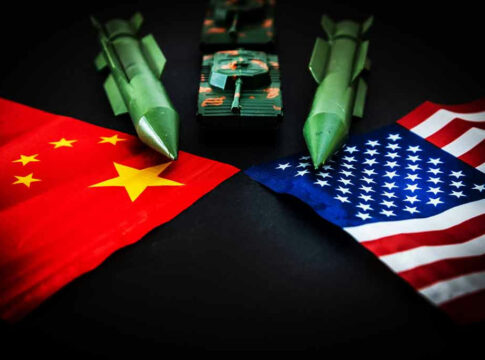
China’s highest-ranking military officer stands accused of handing nuclear weapons secrets to the United States while simultaneously running a corruption network that sold military promotions for cash.
The Nuclear Espionage Claim That Changes Everything
Zhang Youxia spent five decades climbing through People’s Liberation Army ranks to become China’s top uniformed military leader. His position as senior vice chair of the Central Military Commission placed him at Xi Jinping’s right hand, overseeing the world’s largest standing military. The Defense Ministry’s Saturday announcement of his investigation for “serious violations of discipline and law” shocked observers, but the bombshell came from a closed-door briefing leaked to the Wall Street Journal. Senior PLA officers learned Zhang allegedly transmitted core technical data on China’s nuclear weapons program to American intelligence. The accusation marks the first time a sitting CMC vice chair faces espionage allegations involving nuclear secrets.
BREAKING: China’s government has accused their most senior general, Zhang Youxia, of allegedly leaking nuclear weapons secrets to the US.
Zhang has reportedly leaked core technical data on China’s nuclear weapons to the US. pic.twitter.com/CIhGhZeI0A
— The Kobeissi Letter (@KobeissiLetter) January 25, 2026
The Corruption Web Behind The Headlines
The nuclear leak allegation dominates headlines, yet the briefing detailed a sprawling corruption operation that may matter more to Xi’s purge objectives. Zhang allegedly sold military promotions for bribes, cultivated political cliques within the CMC to expand his influence, and supervised procurement processes riddled with kickbacks. These charges mirror patterns seen across Xi’s 13-year anti-corruption campaign that has disciplined over 200,000 officials. The timing proves significant. Zhang’s probe follows October 2025’s expulsion of CMC vice chair He Weidong and connects to ongoing scrutiny of officers Zhang promoted during his tenure. Liu Zhenli, chief of the CMC Joint Staff Department, faces simultaneous investigation, suggesting investigators are dismantling an entire patronage network rather than prosecuting an isolated actor.
Why The Nuclear Leak Story Faces Skepticism
Neil Thomas from the Asia Society Policy Institute voiced doubts shared by many China analysts about the nuclear espionage claims. China’s nuclear weapons program operates under extraordinary security protocols with multiple oversight layers designed precisely to prevent unauthorized disclosures. The PLA monitors senior officers continuously, making sustained intelligence contact with foreign powers exceptionally difficult. Thomas suggests the briefing’s nuclear component may serve political theater more than prosecutorial substance, reinforcing Xi’s narrative about eliminating threats to national security while the real target remains Zhang’s corruption and political maneuvering. No Western intelligence agency has publicly confirmed receiving Chinese nuclear secrets through Zhang. The Chinese government’s official statements emphasize “discipline violations” without mentioning espionage, maintaining ambiguity that serves Xi’s domestic political needs.
The Source Who Burned His Network
Gu Jun’s role adds intrigue to the investigation’s origins. The former general manager of China National Nuclear Corporation allegedly provided evidence implicating Zhang in the nuclear leak accusations. Gu now faces his own separate probe, creating questions about whether he cooperated to reduce his exposure or whether investigators squeezed him for information about Zhang’s activities. The connection between a state nuclear corporation executive and the military’s top ranks illustrates how Xi’s purge crosses institutional boundaries. Authorities seized mobile devices from multiple figures connected to Zhang, suggesting investigators are building cases against an extended network. The evidence trail from China’s civilian nuclear sector into the CMC’s inner sanctum reveals the scope of relationships Zhang allegedly built during his rise.
What This Means For Military Readiness
The purge’s immediate impact shows in command structure disruptions rippling through the PLA. Over 50 senior officers and defense industry executives have faced investigation since 2023, creating leadership vacuums and procurement bottlenecks that slow military modernization efforts. Defense contracts stall as investigators examine relationships between Zhang’s network and suppliers. Officers promoted under Zhang’s watch now face career uncertainty and intensified scrutiny. The timing compounds problems as the U.S. National Defense Strategy, released days before the investigation announcement, designated China as America’s primary deterrence challenge. Regional powers like India are watching closely, calculating how PLA instability might affect disputed borders and Indo-Pacific tensions. Xi prioritizes loyalty over continuity, accepting short-term readiness costs to achieve long-term political control. Whether this calculus serves China’s strategic interests remains an open question as Taiwan concerns and great power competition intensify.
The Ally Xi Couldn’t Protect
Zhang Youxia’s fall demonstrates that proximity to Xi provides no immunity from prosecution when political necessity demands sacrifice. Zhang fought alongside Xi’s father during the civil war era, creating personal bonds that should have insulated him from the purges consuming lesser figures. His removal signals that Xi’s anti-corruption campaign operates beyond personal relationships, targeting anyone who builds independent power bases regardless of past loyalty. The Chinese Embassy frames the investigation as proof of “full-coverage, zero-tolerance” anti-corruption efforts reaching the highest levels. That messaging rings hollow to analysts who see calculated political housecleaning rather than principled reform. Zhang allegedly ran the same promotion-for-bribes schemes that previous defense ministers used before their expulsions, suggesting systemic corruption persists despite years of purges. Social media rumors of coup attempts and military clashes circulated after the announcement but lack credible verification. Such speculation reflects uncertainty about what happens inside China’s opaque power structures when investigations reach the very top.
Sources:
China’s top general accused of leaking nuclear weapons secrets to US — report
China’s Top General Under Probe Over Nuclear Data Leak Claims To US: Report
Power struggle in China’s military leadership: Nuclear weapons data leaked to the US
China’s top general suspected of leaking nuclear secrets to US in exchange for promotions: Report