
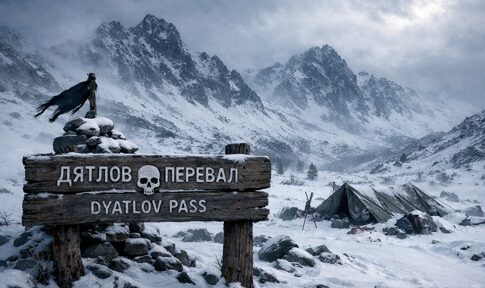
Nine experienced Soviet mountaineers fled their tent half-dressed into sub-zero temperatures, abandoning their only shelter to die in the frozen Ural Mountains with missing eyes, tongues, and injuries comparable to a car crash—a mystery that haunted investigators for six decades until science revealed what terror actually drove them into the night.
The Night Terror Began
Late on February 2, 1959, something went catastrophically wrong on the slope of Kholat Syakhl. Igor Dyatlov’s expedition of nine seasoned winter mountaineers cut their way out of their tent from the inside, fleeing downslope in various states of undress. Search parties discovered the abandoned tent three weeks later, half-buried in snow with gashes sliced through its fabric. The scene suggested pure panic—sleeping bags left behind, boots abandoned, essential survival gear ignored. For experienced mountaineers who understood that shelter meant life in minus-30-degree temperatures, this evacuation defied logic.
The Gruesome Discovery Pattern
Rescuers found five bodies first, scattered between the tent and a makeshift fire approximately 1,500 meters downslope. Yuri Krivonishenko and Yuri Doroshenko died of hypothermia near the fire they had built beneath a cedar tree. Igor Dyatlov, Zinaida Kolmogorova, and Rustem Slobodin perished while attempting to climb back toward the tent, freezing at various stages of their return. The discovery of these five bodies suggested a straightforward hypothermia scenario, albeit with the puzzling question of why they fled their shelter initially.
When the Mystery Deepened
On May 4, 1959, discoveries transformed a tragic hiking accident into an enduring mystery. Four bodies emerged from under four meters of snow in a ravine, 75 meters beyond the cedar tree. These victims—Lyudmila Dubinina, Nikolai Thibeaux-Brignolles, Semyon Zolotaryov, and Alexander Kolevatov—presented injuries that shocked medical examiners. Dubinina and Zolotaryov sustained massive chest fractures. Thibeaux-Brignolles suffered severe skull damage. Medical examiner Boris Vozrozhdenny noted the force required to cause such trauma would equal a car crash. Yet the bodies showed no external wounds corresponding to the internal devastation.
The Missing Tissue That Sparked Decades of Speculation
The macabre details multiplied. Dubinina’s tongue was missing. Eyes had disappeared from several victims. Lips were gone. In 1959 Soviet Russia, with limited forensic understanding and a government prone to secrecy, these findings ignited wild speculation. Theories proliferated: military weapons testing gone wrong, hostile encounters with indigenous populations, infrasound phenomena causing panic, and even extraterrestrial involvement. Reports of orange orbs seen in the sky fed paranormal narratives. The Soviet investigation closed the case, citing “compelling natural force” as the cause of death, a conclusion that satisfied no one and fueled conspiracy theories for decades.
Science Solves What Sensationalism Couldn’t
Modern avalanche science dismantled the mystery methodically. The hikers had dug their tent site into the snow on a slope, inadvertently weakening the snow base beneath their campsite. New snow accumulation created conditions for a slab avalanche—not the dramatic wall of snow from movies, but a slow, pressure-building collapse that gradually compressed the tent fabric. The hikers woke to their shelter closing in on them, the entrance blocked, unable to determine what force was crushing them in darkness. They cut their way out and descended the slope, believing themselves under imminent threat of burial.
The Cascade of Rational Decisions That Proved Fatal
What followed demonstrates how survival decisions can compound into tragedy. The first group built a fire and waited, succumbing to hypothermia when the cold overwhelmed them. Three others, including Dyatlov, attempted to return to the tent for sleeping bags—a logical strategy that failed when hypothermia drained their remaining energy. The final four, better clothed by taking garments from the deceased, continued downslope seeking safer ground. They either fell into a snow hole formed above a stream or were caught in a second avalanche event, sustaining the catastrophic blunt-force trauma that would mystify investigators for sixty years.
The Mundane Truth Behind Missing Facial Tissue
Forensic experts provided the unglamorous explanation for the missing eyes, tongues, and lips that sparked so much dark speculation. The four bodies in the ravine lay face down in running water for approximately two months before discovery. Scavenging animals preferentially consume soft tissue—eyes, tongues, lips—leaving harder tissue and bone. This pattern appears consistently in bodies exposed to wildlife post-mortem. The characteristic injuries had nothing to do with violence, radiation, or unknown forces. They represented the ordinary, if unsettling, process of decomposition and predation that occurs when human remains lie undiscovered in wilderness environments.
Why the Mystery Persisted Despite Evidence
The Dyatlov Pass incident demonstrates how incomplete information, sensational reporting, and human attraction to mystery transform explicable tragedies into enduring enigmas. Soviet secrecy prevented full disclosure of evidence. Early investigators lacked a modern understanding of avalanche science. The dramatic details—torn tent, missing clothing, severe injuries, missing facial tissue—read like horror fiction rather than wilderness accident. Each unexplained element fed speculation that something extraordinary must have occurred. Yet the scientific consensus shows that natural forces, panic responses, and post-mortem processes account for every supposedly mysterious detail.
The Lesson in How We Process Tragedy
This case reveals human nature as clearly as it illuminates avalanche mechanics. We struggle accepting that experienced people can die from misjudgment under pressure, that nature’s violence needs no conspiracies to explain it, and that mundane decomposition produces disturbing results. The truth lacks the narrative satisfaction of sinister plots or supernatural forces. Nine skilled mountaineers made reasonable decisions under terrifying circumstances, and those decisions proved insufficient against the Ural Mountains in winter. The real mystery was never what killed them—it was why we needed their deaths to mean something more than the tragic power of nature combined with human vulnerability.
Sources:
Dyatlov Pass incident – Wikipedia
The Russian Roswell – Science History Institute