
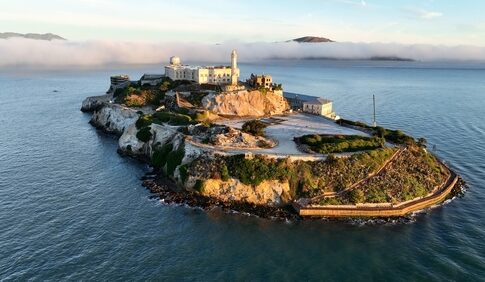
Alcatraz is arguably the most famous name in American penology, yet its life as a federal prison was surprisingly short—spanning only 29 years (1934–1963). Located on a rugged island in the heart of the San Francisco Bay, it was designed not just to hold prisoners, but to break the will of the most incorrigible criminals in the country.
From the “Birdman” to Al Capone, the walls of Alcatraz have seen some of the most notorious figures in criminal history. Here is the story of the island they said no one could leave.
The Fortress Origins
Long before it was a federal penitentiary, Alcatraz had a very different mission. Discovered in 1775 by Spanish explorer Juan Manuel de Ayala—who named it La Isla de los Alcatraces (Island of the Pelicans)—the land was eventually claimed for the U.S. military by President Millard Fillmore in the 1850s.
- The Citadel: During the Civil War, the island served as a fort, bristling with over 100 cannons to protect the bay.
- The Natural Barrier: By the late 1850s, the military began using it to hold prisoners. The logic was simple: the bay’s frigid, high-velocity currents created a “natural wall” that made escape by swimming seemingly impossible.
As the inmate population grew, prisoners were forced to build their own cages. They constructed a massive new cellhouse containing 600 cells, along with a hospital and mess hall—structures that still haunt the island’s skyline today.
Life in the “Inescapable” Prison
Alcatraz was never a high-capacity facility. It averaged between 260 and 275 inmates at any given time—a tiny fraction of the federal population. However, these men were the “worst of the worst”: escape artists, violent offenders, and high-profile gang leaders.
Life on “The Rock” was defined by:
- Minimal Privilege: Inmates were guaranteed only food, clothing, shelter, and medical care. Everything else—including library access and mail—had to be earned through absolute obedience.
- The Goal: If a prisoner could endure the harsh monotony and strict rules of Alcatraz, they might eventually be “promoted” back to a standard federal prison to finish their sentence.
The Rogues’ Gallery
The prison’s reputation was bolstered by its infamous “guest list.” The facility held men guilty of everything from high-stakes bank robbery to cold-blooded murder. Some of the most notable included:
Over three decades, 36 men were involved in 14 separate escape attempts. The statistics speak to the difficulty of the task:
- 23 were recaptured.
- 6 were shot and killed during the attempt.
- 2 were confirmed to have drowned.
- 5 remain missing to this day (officially presumed drowned, though legends of their survival persist).
One of the most violent episodes was the “Battle of Alcatraz” in 1946. Six prisoners overpowered guards and seized weapons, but failed to secure the keys to the outer doors. The resulting standoff lasted two days, claiming the lives of two guards and three inmates.
The End of an Era
In 1963, the heavy iron doors of Alcatraz closed for good. The reason wasn’t a lack of security, but economics.
Operating a prison on an island was a logistical nightmare. Every scrap of food, gallon of water, and liter of fuel had to be ferried across the bay. Furthermore, the salty sea air was literally dissolving the concrete and steel structures. Rather than pay for a massive renovation, the government opted to shutter the facility.
Sources:
The Anti-Immigrant Policies in Trump’s Final “Big Beautiful Bill Act” Explained
The First 100 Days of the Second Trump Administration
The Trump Administration’s 2025 Changes to Immigration Law