
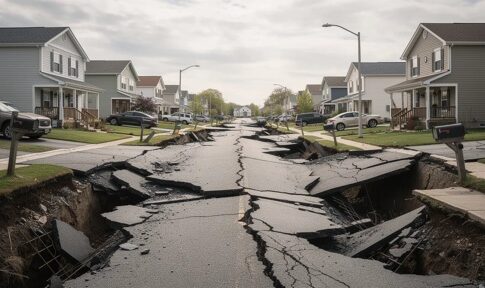
A quiet Utah subdivision is turning into a financial and safety nightmare as homes literally crack and sink—leaving families wondering how “new construction” became unlivable.
Families Say the Ground Is Moving Under Their “Dream Homes”
North Salt Lake’s Winn-Ridge neighborhood has become a warning label for the modern housing boom: homeowners describe foundations splitting, floors dropping, and interior walls separating enough to make living conditions unsafe. Reports first surfaced as minor cracking in early 2024, then escalated sharply by mid-2025 as damage spread across multiple properties. By late 2025 and into 2026, evacuations grew as officials and engineers treated the area as an active hazard zone.
https://youtu.be/BSJazNhWJD0?si=rWPQst8xzKs-hefS
The available reporting emphasizes that this is not a single bad slab or one poorly framed house. Residents have described the issue as neighborhood-wide, with structural failures appearing across many homes. That scale matters because it points investigators toward site conditions—soil behavior, water, compaction, and potential voids—rather than isolated workmanship. For homeowners, it also means typical fixes can become complicated fast, because stabilizing one lot may not solve a shifting area.
There's many cases like this in Utah around new construction. Builders are coming in and cashing out on the manufactured demand craze by building dangerously shoddy houses. Holding them accountable just entangles regular people in lawfare that they can't afford.
How much longer…
— Jonah W. 🌲 (@jonahwrynn) March 17, 2026
What Investigators Are Looking At: Soil, Water, and Subsidence
Geology is central to understanding why a newer subdivision could deteriorate so quickly. The Wasatch Front includes lakebed sediments tied to ancient Lake Bonneville, and parts of the region are known for expansive clay soils that swell and shrink with moisture. Residents and experts have pointed to subsidence and soil instability as key suspects, with heavy rains in 2024–2025 described as a possible accelerator. Deep borings were still expected in 2026 to clarify whether voids, compressible layers, or multiple factors are driving movement.
State-level expertise has carried special weight in the public discussion. The research summary cites Utah Geological Survey drilling that reportedly confirmed significant subsidence—on the order of 10 to 15 feet from soil consolidation—raising the stakes for both safety decisions and liability claims. Even with that kind of measurement, unanswered questions remain about the precise mechanism and how far the affected zone extends. Those uncertainties are one reason engineering recommendations reportedly included potential demolition for some structures.
Developer, City Hall, and Homeowners Clash Over Responsibility
The conflict has taken on familiar lines: residents seeking full recovery, the developer disputing fault, and local government managing an emergency while bracing for litigation. In public statements summarized in the research, the mayor called the situation “unprecedented” and pushed for full geotechnical audits. Ivory Homes, identified as a primary developer for dozens of units, has argued the damage reflects an “act of God” rather than construction failure. Homeowners, meanwhile, have described properties as uninhabitable and pressed for compensation that reflects real replacement costs.
Money and timing are driving the pressure. As of March 2026, the research indicates roughly 28 homes were fully evacuated and about 40 families needed temporary housing. Proposed buybacks at about 70% of value were reportedly rejected by residents—an unsurprising move if homeowners believe the loss is tied to decisions they did not control. A class-action lawsuit filed in February 2026 in Davis County Court reflects how quickly disputes shift from neighborhood meetings to formal discovery, expert reports, and a long road to resolution.
The Bigger Lesson: Growth, Oversight, and Who Pays When It Goes Wrong
Beyond the immediate tragedy, Winn-Ridge highlights a broader policy tension conservatives know well: rapid growth colliding with real-world limits, and ordinary families paying the price when institutions fail to prevent predictable risks. Utah’s housing boom rewarded speed, and the research notes concerns about insufficient geotechnical diligence in fast-moving greenfield development. When problems explode later, the “system” often turns into a maze of insurers, lawyers, and agencies—while homeowners are stuck making payments on homes they can’t safely occupy.
Gorgeous Utah neighborhood of TWENTY ONE newly-built homes begins cracking and sinking into the ground leaving young families distraught https://t.co/AmImogmNKW
— Daily Mail (@DailyMail) March 19, 2026
For now, the most responsible conclusion is also the most frustrating: the neighborhood’s exact cause and ultimate fix remain under investigation, and the court process will likely determine who covers losses. What is clear is that the human cost is already substantial—displacement, collapsing home equity, and community uncertainty. If state and local leaders want to restore trust, they will need transparent findings, enforceable standards, and accountability that doesn’t leave families holding the bag.
Sources:
USC Libraries Writing Guide: Case Analysis
SAGE Journals Article (DOI: 10.1177/16094069231205789)
Hamilton College Writing Resources: How to Write an APA Research Paper