
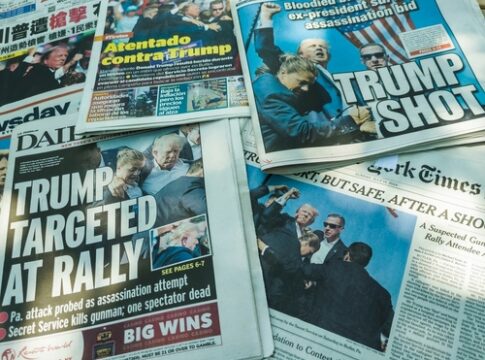
The Secret Service watched Thomas Matthew Crooks for an hour before he fired eight shots at Donald Trump, yet the president stepped onto that Butler, Pennsylvania, stage with no warning whatsoever.
When Protection Becomes Paralysis
The Secret Service had eyes on Thomas Matthew Crooks as he moved through the crowd at the Butler campaign rally. Agents tracked him. They watched him. For approximately 60 minutes, federal personnel monitored the 20-year-old as he positioned himself near the venue.
Yet when Trump walked onto that stage on July 13, 2024, No One told him about the potential threat lurking in the crowd. Trump later told Fox News host Jesse Watters exactly what he knew beforehand: “Nobody mentioned it. Nobody said it was a problem.” The gap between observation and action proved catastrophic.
🚨Incredible new angle of Thomas Crooks basically hiding in plain sight.
Now ask yourself this: How many eyes do you reckon were on this guy, watching the whole thing unfold, and not doing a damn thing to stop him?
The reason this sounds really bad is because it is. pic.twitter.com/ULF1cufUYY
— DK🇺🇸🦅🇺🇸 (@1Nicdar) August 1, 2024
The 26 Seconds That Changed Everything
Crooks climbed onto a rooftop with an AR-style assault rifle and fired eight shots at the president. One bullet struck Trump in the right ear. A Secret Service counter-sniper ended the threat 26 seconds after the first shot rang out, but the damage was done. The shooter’s manner of death was ruled homicide by gunshot wound to the head. Federal investigators later revealed that agents only identified Crooks as an active threat when he retrieved his weapon and scaled the building. Before that moment, he was merely a “person of interest,” a classification that apparently required no immediate intervention or warning to the protectee.
The Political Fallout Begins
JD Vance, who had just joined Trump’s ticket as vice presidential nominee, appeared at his first campaign event in Milwaukee following the assassination attempt. His response raised eyebrows across the political spectrum. Critics characterized his remarks as containing coded references to “elite urban Democrats” and journalists, suggesting these groups bore responsibility for creating the climate that led to the shooting. The Philadelphia Inquirer noted the inflammatory nature of Vance’s positioning. Later, Vance would claim that “political violence, it’s just a statistical fact that it’s a bigger problem on the left,” a statement that PolitiFact and other fact-checkers contested when examining historical data on political violence trends.
A Pattern of Research and Preparation
Investigators discovered that Crooks had researched Ethan Crumbley before executing his attack. Crumbley, whose parents were convicted of involuntary manslaughter for failing to secure firearms and provide mental health support, became a case study for the Butler shooter. This research pattern suggests that would-be attackers study previous incidents, learning from both the tactics and the failures of those who came before them. The detail raises uncomfortable questions about how public information and media coverage of mass violence events might inadvertently provide blueprints for future attackers. Federal investigators continue examining Crooks’ digital footprint and planning timeline.
The Competence Crisis
Republican committee chairman James Comer didn’t mince words. He called the tragedy “preventable” and demanded the resignation of Secret Service Director Kimberly Cheatle. His assessment was blunt: the agency had “become the face of incompetence.” Cheatle herself acknowledged the failure, describing it as the most significant breach of the Secret Service’s protective mission. The admission did little to quell the calls for accountability. How does an agency monitor a threat for an hour without escalating concerns? Why wasn’t Trump pulled from the stage, or at a minimum informed of the potential danger? These questions demand answers beyond bureaucratic explanations about threat assessment protocols and person-of-interest classifications.
When Procedures Trump Protection
The Secret Service’s explanation reveals a troubling priority structure. Crooks remained classified as a person of interest rather than an active threat until he physically retrieved his weapon and climbed onto the roof. This classification apparently dictated the response protocol, or lack thereof. One has to wonder whether the agency’s procedures have become so rigid that common sense takes a backseat to bureaucratic categories. A person of interest loitering near a presidential candidate for an hour should trigger more than passive observation. The distinction between monitoring and protecting seems to have collapsed entirely in Butler, Pennsylvania.
Sources:
Fox News: Trump shooting investigation and attempted assassination in Pennsylvania
Politico: Vance’s statements at RNC following assassination attempt
Le Monde: Trump assassination attempt and Secret Service failure
PolitiFact: Fact-checking JD Vance’s claims about political violence
Philadelphia Inquirer: Analysis of Trump shooting and political rhetoric
Stratfor: Trump assassination attempt and heightened political violence