
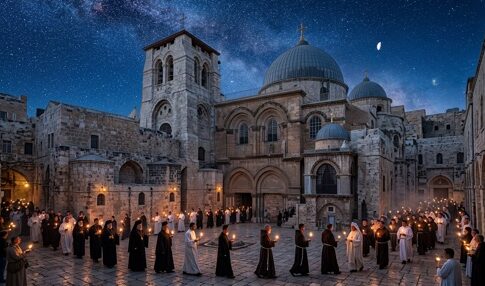
For the first time in centuries, the highest-ranking Catholic cleric in Jerusalem couldn’t celebrate Palm Sunday Mass at Christianity’s holiest site, sparking an international firestorm that exposes how war reshapes even the most sacred traditions.
When Security Trumps Centuries of Tradition
Israeli police denied entry to Latin Patriarch Cardinal Pierbattista Pizzaballa and Custos of the Holy Land Fr. Francesco Ielpo on March 29, 2026, as they attempted to celebrate Palm Sunday Mass at the Church of the Holy Sepulchre. The authorities cited missile threats from the ongoing war with Iran, including fragments that had fallen near the sacred site. The Latin Patriarchate relocated the service, marking the first forced cancellation at this location in living memory and violating agreements dating to Ottoman rule that guarantee Christian self-governance at holy sites.
The denial contradicted what church officials described as prior coordination with authorities for limited worship during wartime restrictions. Israeli Prime Minister Benjamin Netanyahu defended the police action, asserting that security concerns applied equally to all worshipers during active conflict. President Isaac Herzog expressed regret but maintained that the missile threat justified the unprecedented measure. The disconnect between church claims of coordination and police enforcement raised questions about either communication failures or deliberate policy shifts under National Security Minister Itamar Ben-Gvir, known for hardline positions on Jerusalem access.
The Status Quo Nobody Could Break Until Now
The Church of the Holy Sepulchre operates under a delicate “status quo” arrangement established during Ottoman times, granting Christian denominations self-governance rights with Jordanian Hashemite oversight for Muslim and Christian holy sites. Israel has controlled East Jerusalem since 1967, though international courts classify it as occupied territory where restrictions on religious access violate established law. The Palm Sunday blockade shattered this careful balance, prompting the Latin Patriarchate to issue a rare forceful statement condemning the “violation of status quo” and noting the cultural devastation for Palestinian Christians.
The timing magnified the impact. Easter week traditionally floods Jerusalem’s Old City with pilgrims, creating economic lifeblood for local shopkeepers and reinforcing Palestinian Christian identity through public worship. Instead, checkpoints, police stations, and barriers emptied the ancient streets. Business owners reported complete revenue loss during what should have been peak season. The contrast with open worship areas in West Jerusalem highlighted disparities that critics characterized as discriminatory, though Israeli authorities maintained the Old City closure stemmed purely from proximity to missile impact zones and strategic vulnerability during warfare.
International Outrage Meets Wartime Realities
French President Emmanuel Macron condemned Israel’s actions and demanded guarantees for worship rights, while Italian Prime Minister Giorgia Meloni called the blockade an “offense to religious freedom.” The diplomatic rebukes from European allies typically supportive of Israeli security concerns signaled how the Palm Sunday denial crossed traditional red lines. Global Catholic communities watched their highest Jerusalem representative turned away from commemorating Christ’s entry into the city where it historically occurred, creating symbolic damage beyond the immediate logistical disruption of one Mass.
Netanyahu’s promise to devise alternative worship arrangements did little to quiet the backlash. The fundamental issue transcended convenient scheduling: centuries of precedent collapsed in a security decision that, whether justified by genuine missile threats or overreach under Ben-Gvir’s influence, demonstrated how modern warfare erodes protections once considered inviolable. Palestinian Christians, already facing broader movement restrictions, experienced this Easter as confirmation of shrinking space for their community in the land of Christianity’s birth. The long-term implications for interfaith trust and diplomatic relations remain uncertain as the war context that triggered the closure continues without resolution