
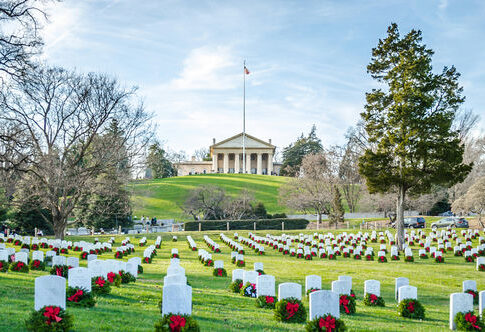
One grave at Arlington National Cemetery carries a warning that still reads like a Cold War-era hazard notice, and it belongs to an Army specialist killed in America’s first fatal nuclear accident.
Story Snapshot
- Arlington National Cemetery identifies Richard Leroy McKinley as the occupant of its only radioactive grave.[3]
- McKinley was one of three victims of the SL-1 reactor accident in Idaho on January 3, 1961.[1][2][3]
- His burial at Arlington was handled with unusual precautions, including a lead-lined casket, concrete, and a metal vault.[2][4]
- The grave remains a rare reminder of how a government project, a military death, and radioactive contamination became permanently linked.[1][2][3]
The Man Behind the Grave
Arlington’s Cold War walking tour identifies the burial site as “Spc. 4 Richard Leroy McKinley” in Section 31, Grave 472, and says the headstone marks Arlington National Cemetery’s only radioactive grave.[3] Find a Grave lists him as Specialist 4th Class Richard Leroy McKinley, born in 1933 and buried at Arlington after dying in 1961 in Butte County, Idaho.[4] The basic identity is not in dispute: McKinley was a U.S. Army service member whose name became part of nuclear history.[3][4]
What made McKinley’s burial different was not symbolism but contamination. Arlington says he was one of three victims of the United States’ first nuclear accident, and Military Times reports that McKinley was still breathing after the SL-1 blast before he later died from his injuries.[1][2][3] The same sources connect his death to the reactor accident at a remote Army facility in Idaho, making the grave a permanent record of a military failure that was both technical and human.[1][2][3]
Check this out. A radioactive grave site. pic.twitter.com/1Atfu5BUhz
— Steve 🇺🇸 (@SteveLovesAmmo) March 28, 2026
Why the Burial Was So Unusual
The reported handling of McKinley’s remains shows how seriously officials treated the radiation risk. Military Times says he was laid to rest in a double lead-lined casket, lowered into a concrete-lined grave, and protected by an additional foot of concrete and a metal vault.[2] We Are the Mighty and Off the Record Tours both describe cemetery instructions warning that the body should not be moved without approval from the Atomic Energy Commission, underscoring that this was a managed radiological case, not a standard military burial.[1][4]
That unusual treatment explains why McKinley’s grave still draws attention decades later. Arlington’s own educational material calls it a radioactive grave tied to America’s first fatal nuclear accident, while other accounts emphasize that the site is safe to visit but remains historically sensitive.[1][2][3][5] For readers across the political spectrum, the story lands on a familiar concern: when large institutions make errors, ordinary families and service members can be left to absorb the cost long after the headlines fade.[1][2][3]
Why the Story Still Resonates
The McKinley grave sits at the intersection of military service, nuclear ambition, and bureaucratic caution. On one level, it is a factual marker of the SL-1 disaster and a veteran’s burial; on another, it is a symbol of how government projects can leave behind lasting physical and moral burdens.[1][2][3] Arlington’s decision to preserve the site as part of its Cold War education material suggests the grave is now treated as both a memorial and a warning about the consequences of high-risk state power.[3]
The broader significance is hard to miss: the United States built nuclear systems to project strength, but in this case the result was a death that required extraordinary containment even after burial.[1][2][4] McKinley’s grave remains one of those rare American sites where history is not abstract or partisan; it is concrete, literally sealed in place, and tied to a disaster that official records still remember as the nation’s first nuclear accident.[1][3][4]
Sources:
[1] Web – America
[2] Web – [PDF] COLD WAR – Education – Arlington National Cemetery
[3] Web – This E-4’s grave is the most dangerous gravesite in the world
[4] Web – The most dangerous gravesite in the US resides in Arlington Cemetery
[5] Web – SP4 Richard Leroy McKinley (1933-1961) – Find a Grave Memorial